Computer Assisted  Learning (CAL) in Honduras

Pioneering education access since 2009

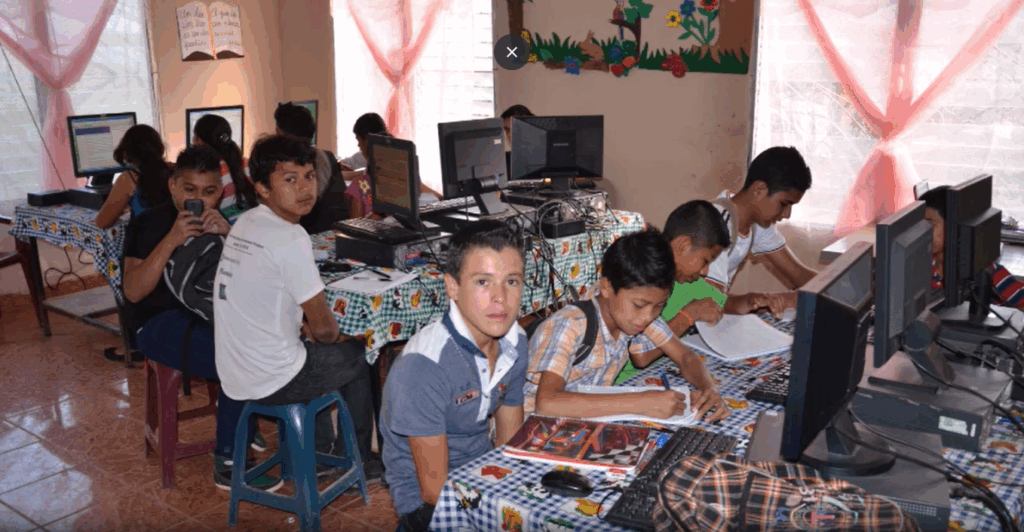
CPI ventured into the field of Computer-Assisted Learning in 2009 by initiating a program for Grades 7-9 in Honduras. A school was opened with 19 students in a rented two-bedroom bungalow in the town of Santa Cruz de Yojoa. Eventually, the increasing enrollment led to a move to a permanent school built by the municipality in 2016.

The first satellite school was opened in 2010 in the remote village of Las Delicias in the mountains of Honduras. A local couple, Trinidad and Teresa Guevara, hosted up to 30 students in their home until 2013, when CPI brought in a shipping container and converted it into a classroom.

By the end of 2023, the program had grown to 791 students in the main school in Santa Cruz and the 25 satellites scattered throughout much of Honduras. Over 4,000 students had completed at least one year of schooling and nearly 2,000 had graduated from Grade 9. The impact of the program on students’ lives is illustrated by a number of stories.

The program has been administered by CPI’s Honduran partner agency Asociación Confraternidad Honduras (ACH) since 2013. On January 1, 2024, responsibility for the oversight and funding of the program was transferred from CPI to the Sombrilla International Development Society.

Program Impact

791+

Current Students

Enrolled in 2023

2,000+

Graduates

Completed Grade 9

26

School Locations

Main + 25 satellites

4,000+

Total Impact

Students served

Village-Building in Honduras

The inability of the landless poor in Honduras to access the formal economy through production has led to much conflict and bloodshed. As a result, many people have fled their home country, most to the U.S. and some to Canada. CPI believes it has a model of peaceful land distribution that could significantly reduce the number of people fleeing violence and economic hardship.
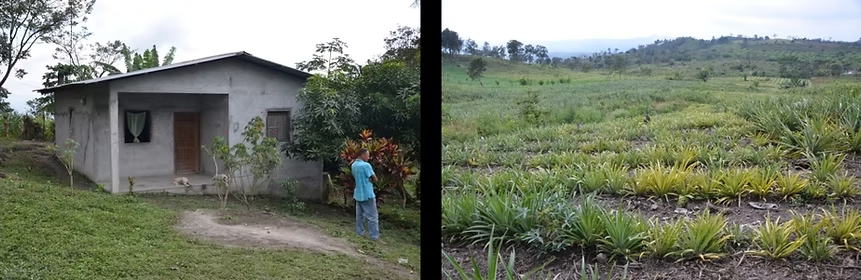
CPI purchased land to build the village of Tapiquilares and provided mortgages to 11 landless families for construction of their homes, plots for growing food, a community centre, and cultivation of pineapples as a cash crop.

Moto-taxi Vocational Training

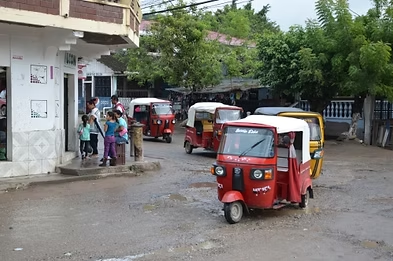
Moto-taxis are a common and affordable means of transportation in Honduras. A donation from the Flaman Foundation enabled CPI to develop a vocational education program for the maintenance and repair of moto-taxis. Staff have assembled a collection of 58 YouTube videos for students to study before they begin to tear down and then reassemble vehicles. The next step is to build a facility in which students will gain hands-on experience working with moto-taxis.
Learning Tours

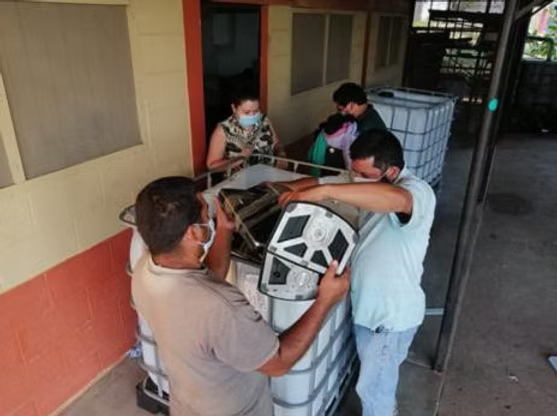
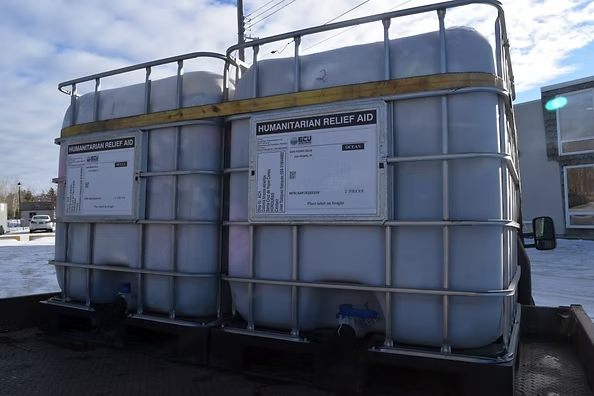
Beginning in 2013, members of CPI’s leadership team organized and led Learning Tours to Honduras to give participants a first-hand look at CPI projects and an opportunity to see various cultural, historical, and natural sites of interest. Most of the computers in use at the CPI schools were donated and collected in Canada and then brought to Honduras by Learning Tour participants.

Hub Leadership

Asociación Confraternidad Honduras (ACH)

Program administration partner since 2013. As of January 1, 2024, oversight and funding transferred to Sombrilla International Development Society.

Photo Gallery
Student Stories

{

Luis, the eldest child in a fatherless family of four, lives in a one-room house in El Ciprés. His mother supports them by making and selling tamales. Luis is essential to this effort, helping to sell them or caring for his younger siblings while his mother travels to market. He was initially puzzled by the suggestion he could learn to make tamales himself—a valuable, unique job skill, though it would mean stepping into the kitchen.

He is grateful for the opportunity to extend his education beyond Grade 6 at Centro de Enseñanza Fraternidad. Without the school, he would be at home with little constructive to do. Luis has proven to be a dedicated student, working hard to become one of more than 15 students on track to complete a grade in less than five months.

{

At nearly 18, Martha lives with her parents and a sister, poised to become the most educated in her family. Her father, a farmer, completed Grade 3, and her mother only Grade 2. Her studies at Centro de Enseñanza Fraternidad offer her a future with new possibilities beyond their current life.

Martha is fortunate to have strong encouragement from her family and friends, many of whom are already young mothers but are happy she has an alternative path. Before school, her days were spent helping at home without the opportunity to dream of a future. Now, she excels academically; after one month, she has completed 75% of her first textbook. If this pace continues, she will finish Grade 7 in just three months. Her goal is to attend high school and possibly study accounting, opening doors her family never had.

{

At 19, Karina is a mother of two young children with a remarkable second chance at education. A gifted student who finished Grade 8 by age 15, her studies were interrupted by pregnancy. Now, through the CAL program at Centro de Enseñanza Fraternidad, she is pursuing her dream of finishing Grade 9 and studying accounting.

Unlike many peers who have abandoned their educations, Karina is steadily progressing and is on track to be one of the program’s first Grade 9 graduates. Her family provides crucial support; her husband, despite his own limited schooling, encourages her, and her mother cares for the toddlers each afternoon. Karina’s parents are thrilled with this opportunity. She hopes her achievements will ultimately allow her to provide a better education and future for her own children.

{

At 53, Gabina bravely returned to school after losing her husband, encouraged by her children. Her own education had been halted at age nine. Despite being the only woman her age in her village with a Grade 6 education, which she recently completed, she now pioneers Grade 7 at Centro de Ensenañya Fraternidad, facing friendly teasing from neighbors.

A dressmaker, Gabina dreams of finishing Grade 9 and then attending dressmaking school to ultimately become a teacher. Her dedication involves a strenuous commute: a ten-minute walk down a steep hill, a 30-minute van ride, and another walk to school for four-and-a-half hours of study. She returns home before dark, climbing the hill again. Her dressmaking income is supplemented by her children, two of whom still live with her. Her youngest daughter, a qualified accountant, works alongside her due to a lack of local jobs.

{

Carol knew her and her two-year-old daughter’s future depended on education, but traditional junior high was impossible. The cost was prohibitive, the schedule rigid, and she couldn’t bring her daughter. At 24, she enrolled in the flexible CAL program at Centro de Ensenañza Fraternidad, attending evening classes where Carol Jr. was welcome.

Carol’s learning was self-paced. Using a computer, she explored subjects like Natural Sciences, diving into topics like water contamination and the hydrological cycle. When her daughter asked for a story, Carol accessed a digital library to read to her. She also discovered new information, like how local pineapples are exported globally. This adaptable model allowed her to learn, care for her child, and manage a job. On December 14, 2014, Carol successfully graduated from Grade 9 with her daughter proudly by her side.